The Modern Guide to Resume Parser ATS Integration - Scaling Your Hiring Workflow
.jpg)
In the fast-paced world of talent acquisition, speed and accuracy are everything. Talent acquisition teams are inundated with thousands of applications for a single open role. Yet, many organizations still struggle with the administrative bottleneck of manual profile creation, data entry errors, and sluggish screening cycles. If your team is buried under a mountain of unstructured PDFs and Word documents, the solution lies in upgrading your core infrastructure.
Achieving a seamless resume parser ATS integration is no longer a luxury for enterprise hiring—it is an absolute necessity. By bridging the gap between raw applicant data and structured database fields, engineering teams can transform a standard human resources platform into an automated, data-driven machine.
In this comprehensive guide, we will explore how a high-performing ATS resume parsing API functions, why deep applicant tracking system integration matters, and how implementing platforms like Digital Resume Parser (DRP) can revolutionize your recruitment operations.
The Core Bottleneck in Modern Recruitment
Every hiring funnel begins with unstructured data. Candidates submit resumes in widely varying formats: multi-column creative layouts, traditional text files, scanned images, and heavily formatted PDFs. Human recruiters spend hours opening individual attachments, scanning for key skills, and manually typing details into candidate profiles.
This manual approach introduces three major risks:
- Time-to-Hire Inflation: While recruiters copy-paste work history, top-tier talent is snatched up by agile competitors.
- Data Degradation: Human data entry is prone to typos, missed certifications, and incomplete histories, rendering search filters useless.
- Poor Candidate Experience: Forcing applicants to fill out lengthy, repetitive application forms leads to incredibly high drop-off rates.
An intelligent resume parser ATS integration eliminates these pain points at the point of ingestion. Instead of forcing human eyes to scan every line, artificial intelligence breaks down the document layout, understands the context, and populates the platform automatically within milliseconds.
What is a Resume Parser ATS Integration?
At its core, a resume parser ATS integration acts as an intelligent translation layer between the applicant and your internal database. When a candidate uploads their CV, the software utilizes natural language processing (NLP) to read the text, extract semantic meaning, and organize it into a structured format like JSON or XML.
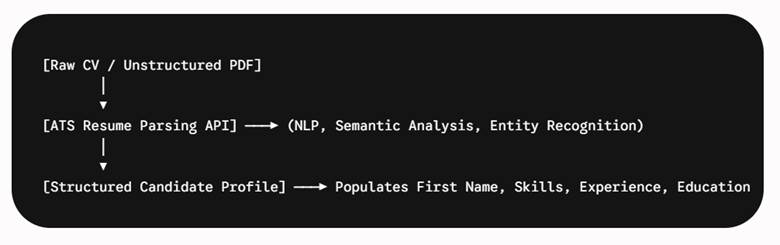
This ensures that every piece of incoming talent data is structured identically, making your entire talent pool instantly searchable, filterable, and scoreable.
Deep Dive: How the ATS Resume Parsing API Works
To build a truly frictionless candidate journey, developers rely on an ATS resume parsing API. This application programming interface allows your existing hiring platform to send a raw document to an external parsing engine and receive structured data back in real-time.
A premium engine, such as Digital Resume Parser, goes far beyond basic keyword matching. It uses sophisticated, multi-layered processing:
- Document Conversion: Converting complex formats (DOCX, PDF, RTF) into clean, machine-readable text while preserving spatial layouts.
- Semantic Enrichment: Understanding that "Python" under a "Skills" heading implies a programming language, whereas "Python" under a "Hobbies" heading might mean something entirely different.
- Entity Resolution: Standardizing job titles and institutions. For example, recognizing that "Sr. Software Engineer" and "Lead Developer" belong to similar career paths.
By integrating a dedicated ATS resume parsing API, developers do not have to waste months building custom machine learning models from scratch. They can deploy a production-ready engine that handles global resume variations instantly.
Architectural Benefits of Deep Integration
When planning your recruitment tech stack, a superficial text-extraction tool is never enough. A robust, end-to-end applicant tracking system integration ensures that data flows naturally into every corner of your HR ecosystem.
- Advanced Search and Sourcing
If your candidate profiles contain clean, structured fields, your internal search engine functions flawlessly. Recruiters can instantly query your database for specific parameters—such as “Software Engineers with 5+ years of experience located within 30 miles of Chicago who know React”—and receive accurate results.
- Elimination of Biased Screening
A deep applicant tracking system integration allows organizations to implement blind hiring practices. Because the data is structured, the system can automatically mask demographic information, names, or graduation years before presenting profiles to hiring managers, promoting diversity and merit-based shortlisting.
- Automated Talent Matchmaking
Modern AI engines don't just extract information; they score it against job descriptions. With a fully realized applicant tracking system integration, incoming profiles can be automatically cross-referenced with active vacancies, instantly highlighting high-match candidates the moment they apply.
Implementation Roadmap: A Complete Guide
Successfully upgrading your stack requires a deliberate approach. Here is a complete guide to integrating AI resume parsing with your applicant tracking system seamlessly, ensuring high data fidelity and low latency.
Step 1: Assess Data Requirements and Schema Mapping
Before writing code, map your existing database schema to the parser's output fields. Identify exactly how contact details, employment history, education segments, and skills taxonomies will align.
Step 2: Establish Secure API Connectivity
Connect your system to a secure, scalable engine like Digital Resume Parser via HTTPS. Ensure your development team configures proper error handling, timeout thresholds, and secure API key management to safeguard candidate privacy.
Step 3: Implement Real-Time Ingestion
Configure your application portal's front end to trigger the parser the exact moment a file is uploaded. This allows you to instantly pre-populate application fields for the candidate, giving them a chance to review and confirm their details, which drastically boosts application completion rates.
Step 4: Run Rigorous Edge-Case Testing
Test the pipeline using complex document types: multi-column resumes, tables, unconventional fonts, and photo-based PDFs. A high-grade parser will handle these variations effortlessly, maintaining structural integrity across your entire database.
Following this complete guide to integrating AI resume parsing with your applicant tracking system ensures your development cycle remains short, predictable, and highly secure.
Choosing the Right Partner: Digital Resume Parser
Not all parsing software is built equal. Legacy keyword matchers frequently trip over modern resume designs, leading to scrambled text and broken workflows.
Platforms like Digital Resume Parser (DRP) solve this by utilizing advanced AI models explicitly trained on global recruitment data. DRP offers a highly scalable, lightning-fast ATS resume parsing API designed to integrate smoothly into any tech stack. With comprehensive multi-lingual support, stellar uptime, and highly granular data extraction, DRP provides the structural backbone necessary to power modern enterprise recruitment.
Conclusion
Maximizing hiring efficiency starts at the very beginning of the candidate journey. Relying on manual data entry or outdated extraction techniques costs your business time, money, and elite talent. By implementing a high-performance resume parser ATS integration, you unlock a fully automated, lightning-fast ingestion pipeline that empowers recruiters to focus on what they do best: building human connections and selecting top talent.
Ready to Transform Your Recruitment Process?
Stop letting unstructured data slow down your hiring velocity. Experience firsthand how a dedicated ATS resume parsing API can eliminate administrative overhead, optimize your database, and scale your talent operations.
Visit Digital Resume Parser today to explore our documentation, request a personalized demo, or start your free trial. Let’s build a smarter, faster, and more efficient hiring experience together.