Navigating GDPR Resume Parsing - The Ultimate Guide to HR Data Compliance
.jpg)
The modern recruitment landscape moves fast. In HR, speed is everything. When a single job posting can attract hundreds of applicants within hours, relying on manual screening is no longer a viable strategy. This operational bottleneck is why human resource departments globally rely on automated parsing solutions. Tools like Digital Resume Parser (DRP) have transformed the industry, transforming unstructured CVs into clean, structured data in seconds.
However, with great efficiency comes significant responsibility. Resumes are not just data points; they are collections of highly sensitive, personally identifiable information (PII). From home addresses and phone numbers to employment histories and educational backgrounds, a candidate's resume contains their life story.
In an era governed by strict regulatory frameworks, processing this data carelessly can lead to devastating legal and financial consequences. For talent acquisition teams, implementing robust GDPR resume parsing workflows is no longer optional—it is a foundational legal necessity.
The Intersection of AI Recruitment and Legal Mandates
When the European Union introduced the General Data Protection Regulation (GDPR), it fundamentally altered how businesses handle personal data. Recruitment was one of the hardest-hit sectors. Because hiring inherently involves collecting vast amounts of personal info from people who haven't even signed a contract with you yet, the stakes for maintaining strict HR data compliance are incredibly high.
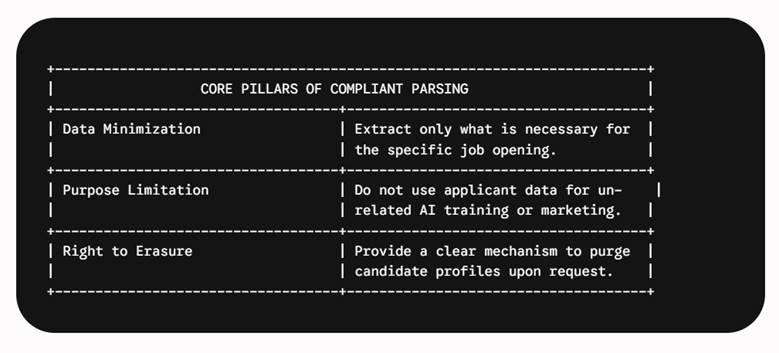
For teams leveraging automation, the challenge is twofold: you need a tool that accurately reads resumes, but you also need that tool to handle data according to strict European privacy standards. The GDPR compliance requirements for AI resume parsing tools used by HR teams dictate that any software processing candidate information must design its architecture around data minimization, purpose limitation, and robust security.
When you use a platform like DRP, compliance isn't treated as a bolt-on feature. Instead, it is baked into the engine. A compliant parser ensures that candidate data is processed lawfully, transparently, and only for the specific purpose of evaluating job fit.
Why "Consent" is Only the First Step
Many hiring managers falsely assume that adding a quick privacy checkbox to their application page completely solves their compliance worries. While getting explicit consent is crucial, true candidate data privacy goes much deeper than an application form opt-in.
Under global privacy laws, candidates retain several fundamental rights over their data even after they hit "Submit." These include:
- The Right to Be Informed: Candidates must know exactly how their data is being parsed, stored, and evaluated.
- The Right of Access: Applicants can request a copy of the structured data your parser extracted from their CV.
- The Right to Erasure ("Right to be Forgotten"): If a candidate asks to be removed from your database, every trace of their parsed data must be cleanly deleted.
If your automated parser stores candidate profiles indefinitely on unencrypted external servers, or uses their data to train public AI models without permission, you are actively violating these rights. Secure GDPR resume parsing requires a system that respects these boundaries, allowing for automated data retention schedules and seamless data deletion protocols.
Selecting the Right AI Tool: What HR Teams Must Audit
Not all resume parsers are built with privacy in mind. Many legacy systems or cheap APIs scrape data and store it in insecure environments, leaving your organization vulnerable to massive data breaches and compliance audits.
When evaluating vendors, security officers and talent acquisition leaders must closely analyze the technical GDPR compliance requirements for AI resume parsing tools used by HR teams. A truly compliant platform must offer:
- Enterprise-Grade Encryption: Data must be encrypted both while it is traveling to the parser (in transit) and while it is being processed or stored (at rest).
- Zero-Data Retention Options: For ultimate peace of mind, premium parsers like DRP offer stateless processing. This means the tool extracts the text, passes the structured JSON back to your Applicant Tracking System (ATS), and immediately wipes the data from its own processing servers.
- Geographic Data Sovereignty: GDPR explicitly mandates restrictions on transferring personal data outside the European Economic Area (EEA) unless specific safeguards are met. Your parser vendor should explicitly state where their servers live and how they handle cross-border data flows.
By vetting these features, you transform your recruitment funnel from a potential legal liability into a shining example of excellent HR data compliance.
Cultivating Trust Through Candidate Data Privacy
Beyond avoiding multi-million euro fines, prioritizing privacy is an incredible branding tool. Today’s job seekers are highly aware of data security. They care deeply about who has access to their personal history.
When a company openly demonstrates that it values candidate data privacy, it builds immediate goodwill with top-tier talent. Showing candidates that your automated screening tools—like Digital Resume Parser—handle their professional backgrounds with absolute confidentiality sends a clear message: We respect your data, and we respect you.
Furthermore, aligning your automated workflows with GDPR resume parsing standards prepares your enterprise for the future. Data privacy regulations are tightening worldwide, not just in Europe. Embracing high privacy standards today ensures your HR tech stack is ready for tomorrow's legal updates, saving your team from chaotic, reactionary software overhauls down the road.
Conclusion: Efficiency Without Compromise
Recruitment automation and data protection do not have to be at war. You don't have to sacrifice the speed of AI screening to stay on the right side of the law. By partnering with a dedicated, security-first parsing vendor, your HR team can enjoy lightning-fast candidate screening while maintaining absolute peace of mind.
Adhering to strict HR data compliance protocols protects your company’s finances, elevates your employer brand, and ensures that you honor the fundamental rights of every applicant who trusts you with their resume.
Ready to Upgrade Your Recruitment Security?
Don't let an outdated parser expose your organization to compliance risks. Streamline your hiring pipeline safely with Digital Resume Parser. Our sophisticated, AI-driven parsing engine delivers industry-leading accuracy while strictly honoring global privacy mandates.